





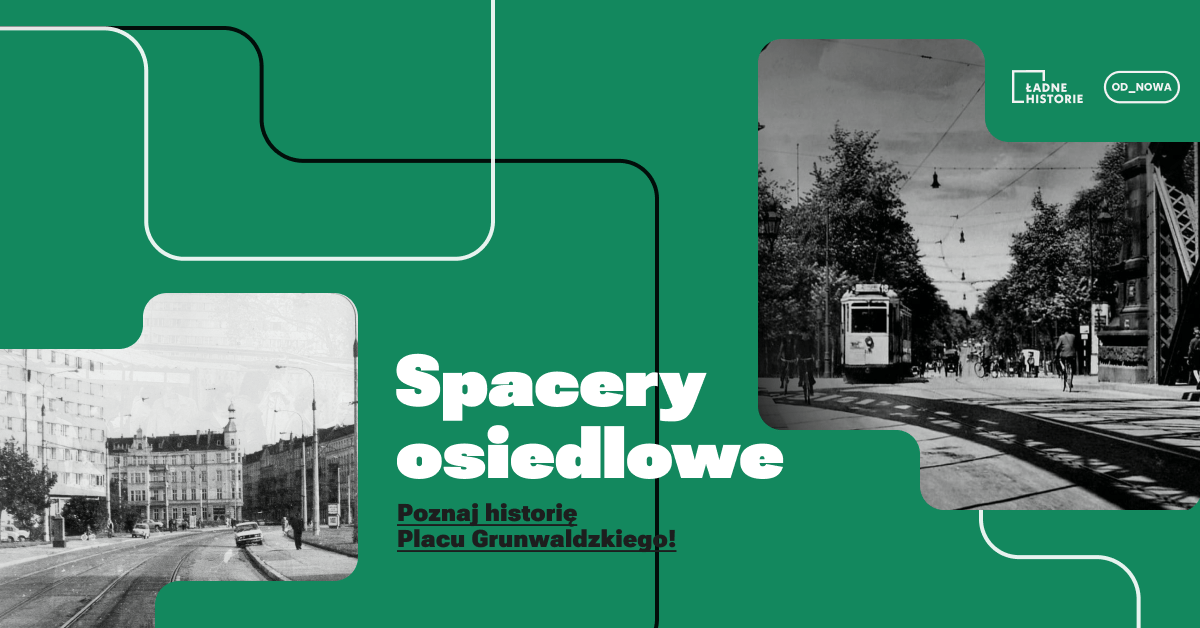
We're returning to the walking trails to discover the untold story of Grunwaldzki Square. We'll explore downtown legends, forgotten places, and the vivid memories of those connected to Grunwald, presented by Wrocław architects, historians, and city guides. Get your comfortable shoes ready, because from August to October, we'll be taking five walking tours!
graphic design: Marcin Rosiński
As part of the "Plac Grunwaldzki – An Untold Story" project, we invite you to participate in a series of five guided autumn walks. We'll learn from behind the scenes about the construction of the airport at Grunwaldzki Square. We'll also learn how socialist realist architecture and iconic modernist projects came to be. We'll also hear stories about streets and buildings invisible to the naked eye, yet etched into the history of the neighborhood, as well as the memories of those who lived in Plac Grunwaldzki before and after the war.
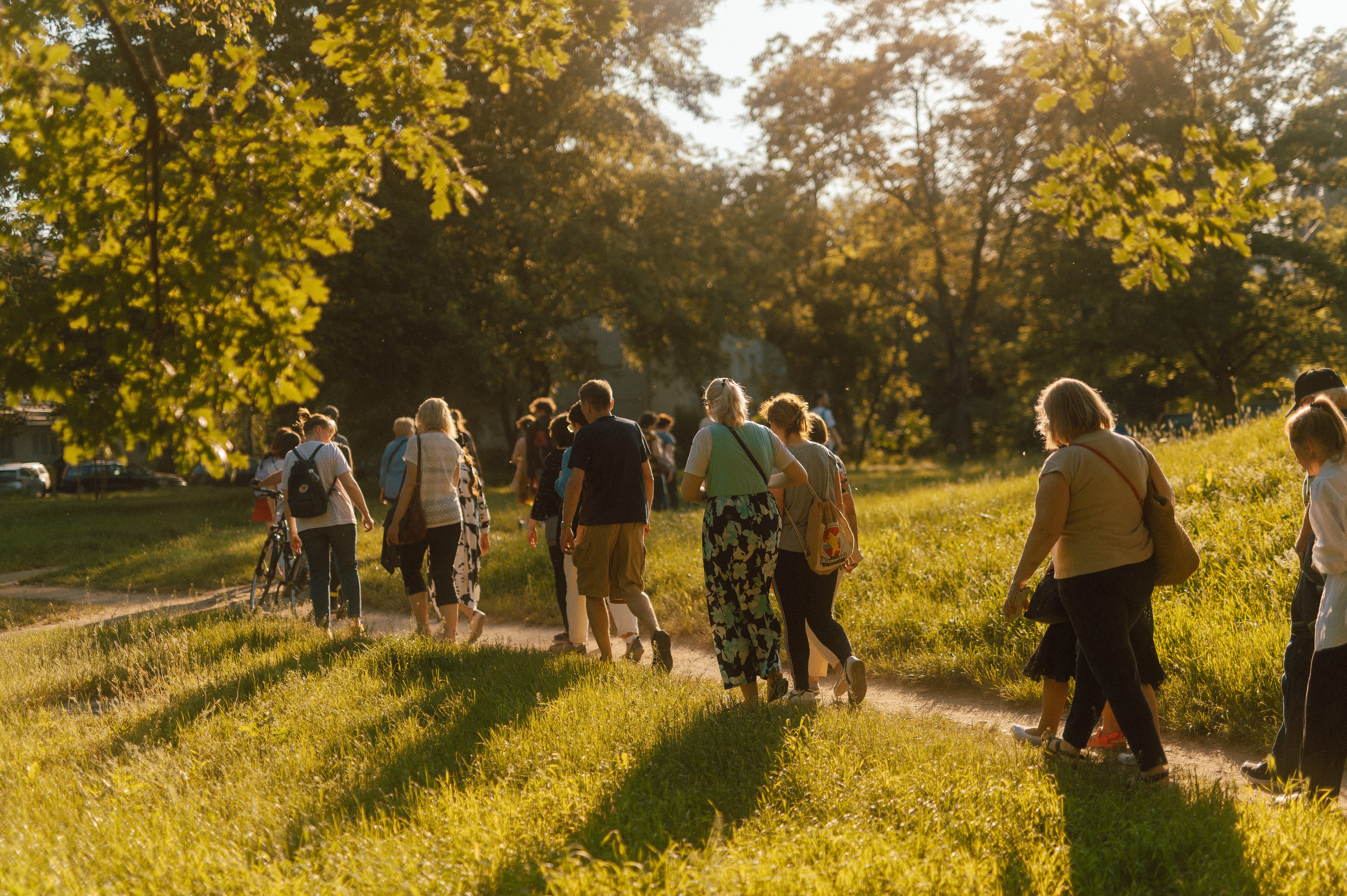
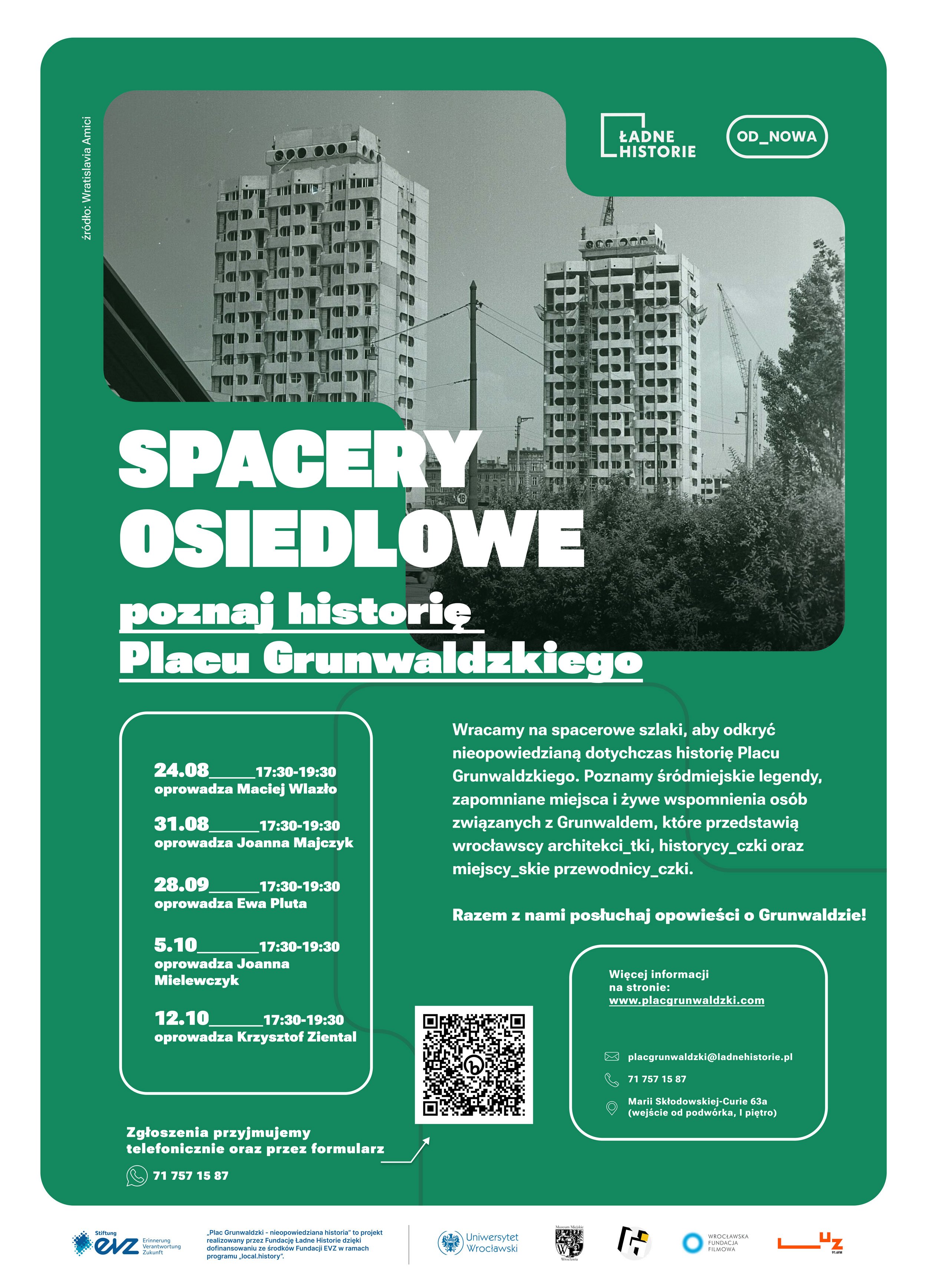
All walks will take place on selected Thursdays in August, September, and October, and will run from 5:30 PM to 7:30 PM each time. Meeting points and directions can be found under each event description.
What do you need to do to take part in the walks?
Participation in the walks is free of charge, but prior registration is required via the form: bit.ly/NIEOPOWIDZIANAhistoriaGRUNWALDwalksREGISTRATIONS.
Submitting an application for participation is tantamount to accepting the provisions of the regulations: bit.ly/NIEOPOWIDZIANAhistoriaGRUNWALDuwalksRULES.
Walking schedule:
- August 24, 5:30 PM - 7:30 PM – Stories and myths surrounding the construction of the airport at Grunwaldzki Square | guided tour by Maciejj It got in // [NO PLACES AVAILABLE]
During this walk, we will learn about the ambitious plans for the development of a new, proud, and ambitious city that grew around the Szczytnicka Star ("Scheitniger Stern") and was interrupted by the greatest tragedy in our city's history: the siege of Festung Breslau. We will learn what led to the construction of the runway at Grunwaldzki Square and its consequences. We will learn the behind-the-scenes details of the plans to demolish the Grunwald Axis. We will demystify the myths and legends that have grown up around those dramatic days and weeks of World War II. We will listen to the voices of witnesses and their stories.
Start: Monument to the victims of the airport construction at Grunwaldzki Square, Wybrzeże Pasteur 20
Finish: Grunwaldzki Bridge
Directions to the meeting point: "Kochanowskiego" stop by tram numbers: 9, 17, 33 or by bus numbers: 111, 116, 121, 131, 149, 151, D.
- 31/08, 17:30-19:30 – Archiwalk around Grunwaldzki Square, following the great plans from the second half of the 20th century | guided by Joanna Majczyk
The year is 1949. Socialist realism becomes the sole accepted method of creative expression in Poland. Grunwaldzki Square becomes the apple of Wrocław's urban planners' eyes. The propaganda enthusiasm doesn't last long. In 1956, socialist realism was doctrinally rejected, along with the "grand plans" for the redevelopment of Wrocław's city center. But what remains in Grunwaldzki Square today? During the walk, we'll see, among other things: university campuses and flagship architectural achievements of Wrocław's socialist realism, urban traces of the "grand plans" of the 1950s, and the former Breslau, the first new building erected in the city after 1945.
Start: The square near the Three Fountains Complex next to the Grunwaldzki Bridge, Stanisław Wyspiański Coast
Finish: Crayon and Pencil, Plac Grunwaldzki 30
Directions to the meeting point: stop "Most Grunwaldzki" by tram numbers: 4, 16, 19, 33, 70 or by bus numbers: 145, 146, 149, D.
- 28/09, 17:30-19:30 – About the relationship between architecture and people – non-existent buildings and important people | guided tour by Ewa Pluta
Plac Grunwaldzki is the housing estate in the northern part of Wrocław that was most severely damaged during the war. Once a prestigious district, it has been transformed into a gaping void. Its architecture is gone, along with those who built their family and professional lives within its walls. During the walk, we will follow the trail of now-vanished buildings, learning about their architecture and significance for the city. But above all, we will explore the biographies of the men and women associated with them. The route includes the churches of Peter Canisius and Martin Luther, the State Archives, Heimann's villa, the seat of the legendary Segita, and the registry office.
Start: Monument to the victims of the construction of the airport in besieged Wrocław, Wybrzeże Pasteur 20
Finish: Monument to the Murdered Lviv Professors, between the buildings of the Polytechnic University D1 – D2
Directions to the meeting point: "Kochanowskiego" stop by tram numbers: 9, 17, 33 or by bus numbers: 111, 116, 121, 131, 149, 151, D.
- 5.10, 17:30-19:30 – In the footsteps of pre- and post-war inhabitants of Wrocław | guided tour by Joanna Mielewczyk
We invite you to a story about the architects, doctors, and artists who settled in tenement houses in this part of Wrocław after the war, and about those who lived in Grunwald before the war. We begin at Łukasiewicza 13 to learn what cherries tasted like in Volhynia and which Lviv psychiatrist saw patients there. We will also trace the fates of professors from Wrocław's universities. We will continue along Norwida Street to Skłodowska-Curie Street to learn about the complex postwar fates of Wrocław's Jewish residents. We will also hear the story of an extraordinary postwar friendship and two neighbors who met in Berlin after more than 70 years.
Start: Tenement house, 13 Łukasiewicza Street
Finish: Tenement house, Pasteura Street 16
Directions to the meeting point: stop "Kliniki – Politechnika Wrocławska" by tram numbers: 1, 2, 4, 10, 16, 19 or by bus numbers: 115, 145, 146, 315, 345.
- 12/10, 17:30-19:30 – From Auditorium to Auditorium, or a walk along Grunwaldzki Square in the footsteps of modernist architecture | guided by Krzysztof Ziental // [NO PLACES AVAILABLE]
In 1964, a competition was announced for the expansion of Wrocław's scientific district near Grunwaldzki Square. The winning design, by architects Krystyna and Marian Barski, is not only impressive in its monumentality but also in its modernity. Four higher education institutions (the University, the University of Technology, the then Agricultural University, and the Medical Academy) were clustered along the Grunwaldzki axis, intended to create a modernist district, brimming with young students. During the walk, we will learn about the most important urban elements of this development. We will try to discern its original expression and meaning, unfortunately only partially preserved in the original architecture. Therefore, this will be a walk not only of sightseeing but also of remembrance.
Start: University of Wrocław Chemistry Auditorium, Joliot-Curie Street 13
Finish: Veterinary Clinic of the University of Life Sciences, Plac Grunwaldzki 51
Directions to the meeting point: „Most Grunwaldzki” stop by tram numbers: 4, 16, 19, 33, 70 or by bus numbers: 145, 146, 149, D or „Katedra” stop by tram numbers: 2, 9, 10, 23 or by bus numbers: 106, 111, 115, 148, 315, A, N.
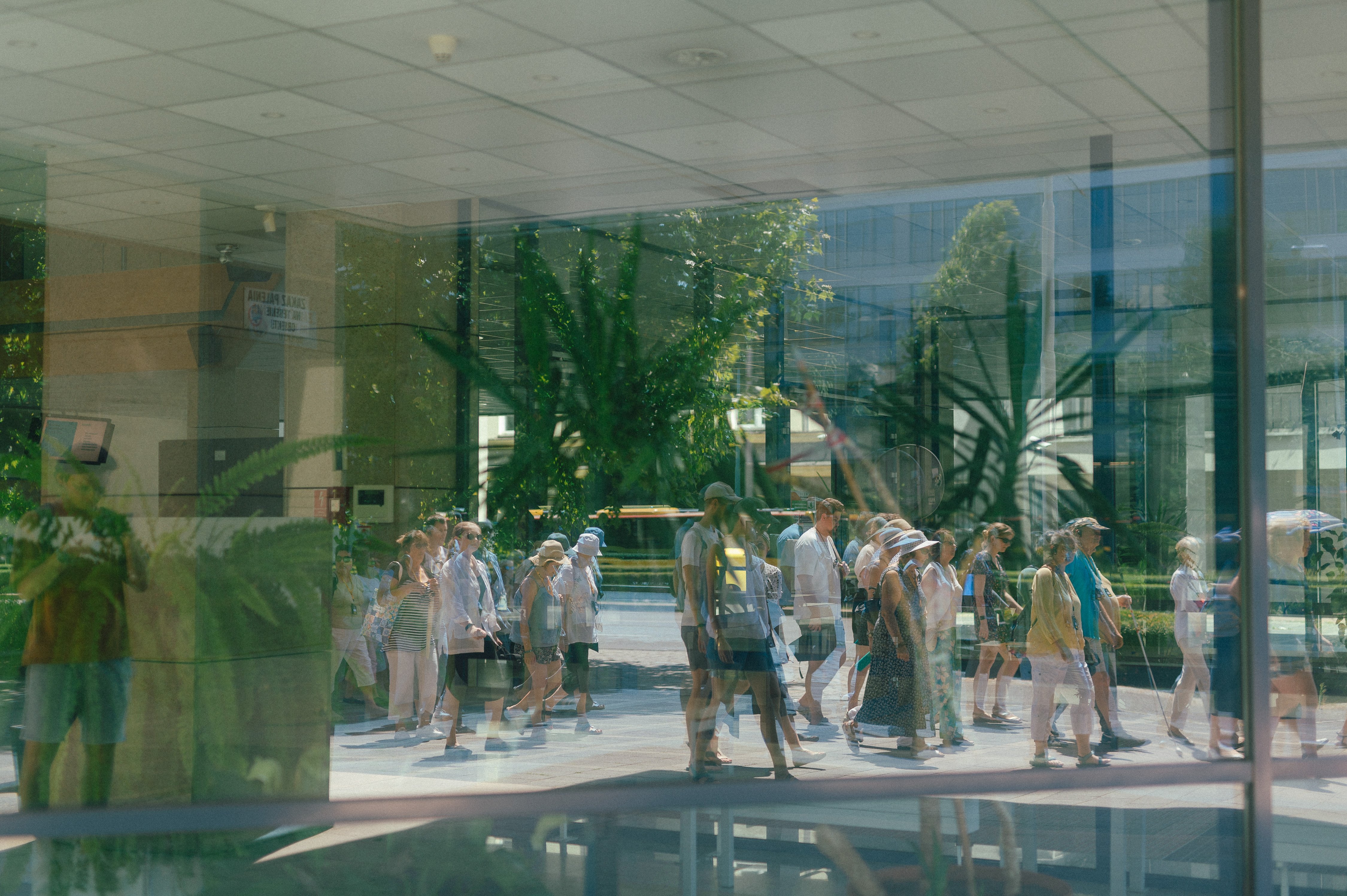
photo: Marcin Szczygieł
About the presenters:
- Maciej Wlazło A passionate city guide around Wrocław. On social media, as the Beard of Breslau, he describes and comments on the state of the German heritage remaining in Wrocław and Lower Silesia, and shares historical curiosities related to the city and region. He educates about Wrocław's lesser-known history by giving lectures, readings, and organizing city walks. He collaborates with Radio Wrocław on YouTube videos titled "Wrocław by Walk.".
- Joanna Majczyk – architect and assistant professor at the Faculty of Architecture, Wrocław University of Science and Technology. She researches 20th-century architecture, its creators, and the relationship between architecture and politics.
- Ewa Pluta – a cultural worker and art historian, professionally associated with the Wrocław City Museum and the Art Transparent Foundation. A spokesperson, curator, accessibility coordinator, and occasional guide, she considers Wrocław the most wonderful city in the world (despite its lack of a sea). She compulsively explores its history to uncover the yet-to-be-discovered threads. She is particularly interested in Wrocław's herstory and queer history. A proud resident of Ołbin, she has a dog and a cat.
- Joanna Mielewczyk – Radio journalist, associated with Radio Trójka for 12 years and with Wrocław's Radio RAM for 5 years. Graduate of journalism at the University of Wrocław. Author of 215 interviews about pre- and post-war Wrocław and the books "Kamienice" (Tenement Houses), based on radio broadcasts. Mother of two wonderful sons. A fan of modernism and an observer of Art Nouveau.
- Krzysztof Ziental – Wrocław resident, art historian, monument and conservation expert, participatory practitioner, and civil servant. Author of the publication "Krystyna Postawka-Barska and Marian Barski" (SARP–Wrocław, Wrocław 2016) from the series "Wrocław Masters of Architecture." Co-author of nearly thirty conservation studies. Currently, Head of the Participation Department of the Social Participation Department of the Wrocław City Hall. Coordinator of over a hundred consultation processes. Co-editor of the Wrocław Talks website – a social participation portal, and supervisor of Microgrants – a city-wide program supporting grassroots initiatives. A guide to the city's architecture and history. To date, he has given tours of Wrocław's Szczepin, Karłowice, Różanka, Dąbie, Kleczkowo, Nadodrze, Ołbin, Partynice, Grunwaldzki Square, Popowice, Tarnogaj, Zakrzów, and Kalisz.
graphic design: Marcin Rosiński
„Plac Grunwaldzki – an untold story” is a project carried out by the Ładne Historie Foundation thanks to funding from the EVZ Foundation as part of the „local.history” program.
The project was supported by the EVZ Foundation. This publication does not represent the opinion of the EVZ Foundation. The author bears responsibility for any statements contained herein.

